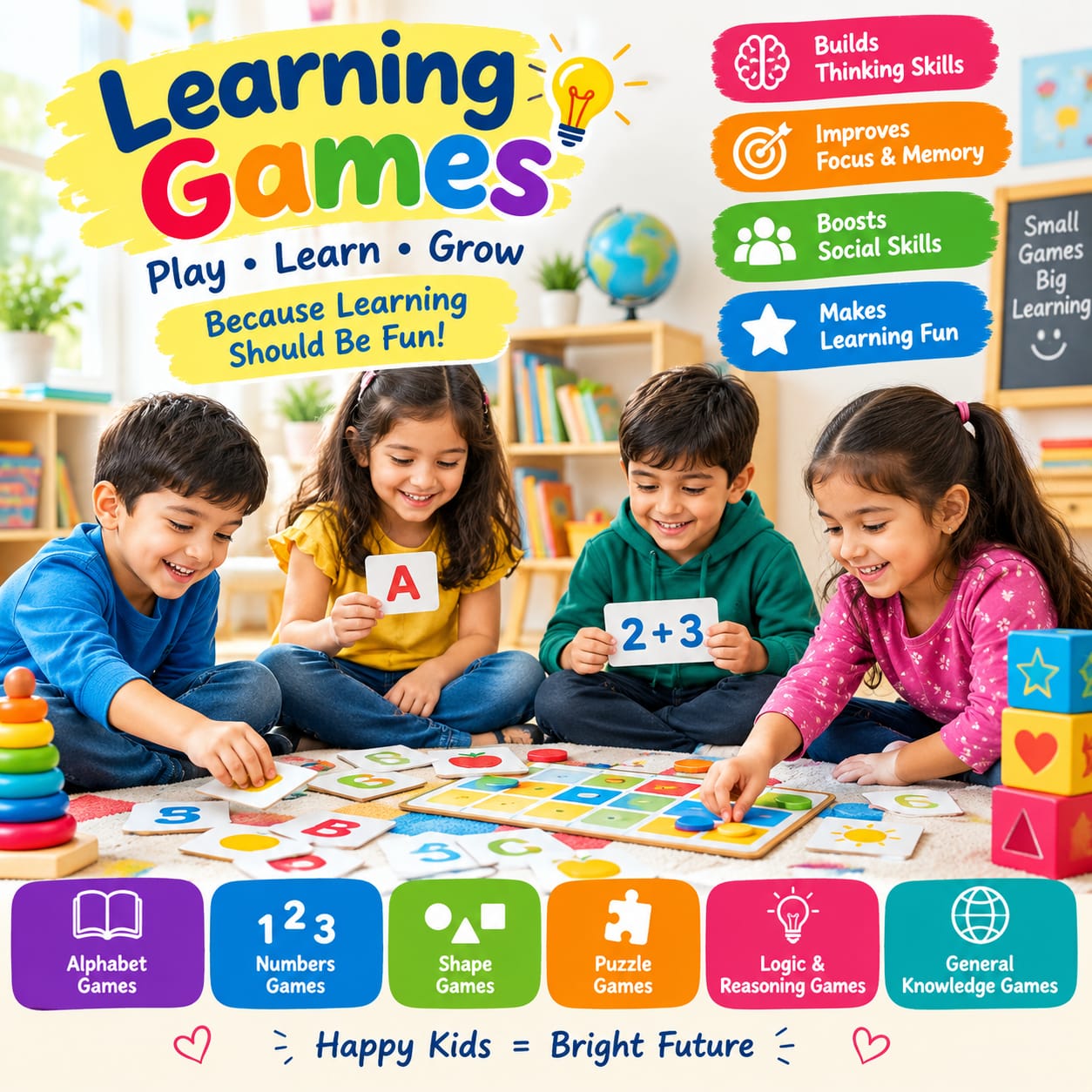
Learning doesn’t always have to happen through textbooks and homework. Children can learn important skills while playing, exploring, and having fun. Learning games for kids are a great way to combine education with entertainment and help children develop skills such as problem-solving, memory, creativity, communication, and logical thinking.
Parents can easily introduce learning games at home using simple toys, household items, or educational activities. The best part is that children often learn naturally when they are enjoying themselves.
Why Are Learning Games Important for Kids?
Children are naturally curious. Games give them an opportunity to explore new ideas and understand concepts through practical activities.
Learning games can help children:
Improve memory and concentration
Develop problem-solving skills
Learn numbers and basic mathematics
Recognize letters, words, and sounds
Improve hand-eye coordination
Develop creativity and imagination
Learn teamwork and communication
Build confidence
Practice decision-making
Develop patience and logical thinking
Instead of making learning feel like a task, games can make it an enjoyable part of everyday life.
10 Fun Learning Games for Kids
1. Alphabet Matching Game
Write letters of the alphabet on small cards. Make another set of cards containing pictures or simple words.
Ask your child to match the correct letter with the corresponding word or picture.
For example:
A → Apple
B → Ball
C → Cat
This simple activity helps children become familiar with letters and words.
2. Number Hunt
Number Hunt is an easy game for young children who are learning numbers.
Write numbers from 1 to 20 on pieces of paper and hide them around the room. Give your child a number and ask them to find it.
You can make the game more challenging by asking children to find numbers in a particular order.
This activity helps improve number recognition and concentration.
3. Memory Card Game
Place picture cards face down on a table. Children have to turn over two cards at a time and remember where each picture is located.
The goal is to find matching pairs.
Memory games are useful for developing concentration, observation, and memory skills.
4. DIY Puzzle Challenge
You don't always need expensive educational toys to create a learning activity.
Take a picture, draw something simple, or print a colorful image. Cut it into several pieces and mix them up.
Ask your child to put the pieces together.
As children solve the puzzle, they practice visual thinking, patience, and problem-solving.
5. Counting with Everyday Objects
Learning mathematics can be much easier when children can see and touch objects.
Use toys, blocks, pencils, buttons, or other safe household objects for counting activities.
For example, ask:
“Can you count five blocks?”
Then try simple addition:
“You have 3 blocks. If I give you 2 more, how many do you have?”
This introduces basic mathematical concepts through play.
6. Color Sorting Game
Collect objects of different colors and ask children to sort them into groups.
For example:
Red objects
Blue objects
Green objects
Yellow objects
You can use building blocks, balls, paper shapes, or other child-safe items.
This activity helps children learn colors while developing observation and classification skills.
7. Build and Create
Building games are excellent for developing creativity.
Give children building blocks, LEGO-style pieces, cardboard boxes, or other suitable construction toys and ask them to create something.
You can give them challenges such as:
Build a house
Make a bridge
Create a tower
Build a small vehicle
Design a playground
These activities encourage creativity, planning, and problem-solving.
8. Word Guessing Game
Choose a simple word and give your child clues about it.
For example:
“It is yellow, it is a fruit, and monkeys like it.”
The answer is banana.
As children become more comfortable, allow them to give clues to you.
This game helps improve vocabulary, communication, and thinking skills.
9. Shape Hunt
Ask children to find objects around the house that match different shapes.
For example:
Circle: Plate
Rectangle: Book
Square: Tile
Triangle: Certain road signs or toys
You can turn the activity into a small competition by giving children a few minutes to find as many shapes as possible.
10. Story Building Game
Start a simple story with one sentence.
For example:
“One day, a little rabbit went into the forest…”
Then ask your child to continue the story.
Each person can add one sentence at a time.
This activity encourages imagination, language development, creativity, and communication.
How Parents Can Make Learning Games More Effective
Parents don't need to make every activity complicated. Simple games can provide valuable learning opportunities when children are encouraged to participate actively.
Here are some useful tips:
Keep Games Age-Appropriate
Choose activities according to your child's age and development level. A game that is too easy may become boring, while a game that is too difficult may become frustrating.
Keep Sessions Short
Young children may have limited attention spans. Short and enjoyable activities are often more effective than long sessions.
Let Children Explore
Try not to provide the answer immediately. Give children time to think, experiment, and make mistakes.
Use Positive Encouragement
Praise children's effort rather than focusing only on whether they got the correct answer.
Simple words such as “Good try!”, “Let's try again,” or “Great idea!” can encourage children to keep learning.
Make Learning Part of Daily Life
Learning games don't have to happen only during a specific study time.
Counting toys, identifying colors while shopping, reading signs, or creating stories during bedtime can all become learning opportunities.
Learning Through Play
Play is an important part of childhood. When children play educational games, they can practice different skills without feeling like they are doing traditional schoolwork.
The goal isn't to turn every game into a lesson. Instead, parents can create an environment where children naturally learn while having fun.
A simple puzzle can teach problem-solving. A building game can encourage creativity. A counting game can introduce mathematics. A story game can improve vocabulary.
Final Thoughts
Learning games for kids can make education more interactive, enjoyable, and meaningful. From memory cards and puzzles to counting games and storytelling, there are countless activities parents can try at home.
The most important thing is to choose games that match the child's interests and age. Give children freedom to explore, ask questions, make mistakes, and try again.
When learning becomes part of play, children can develop valuable skills while enjoying the process.
Comments (0)
No comments yet. Share your thoughts below!
Leave a Comment