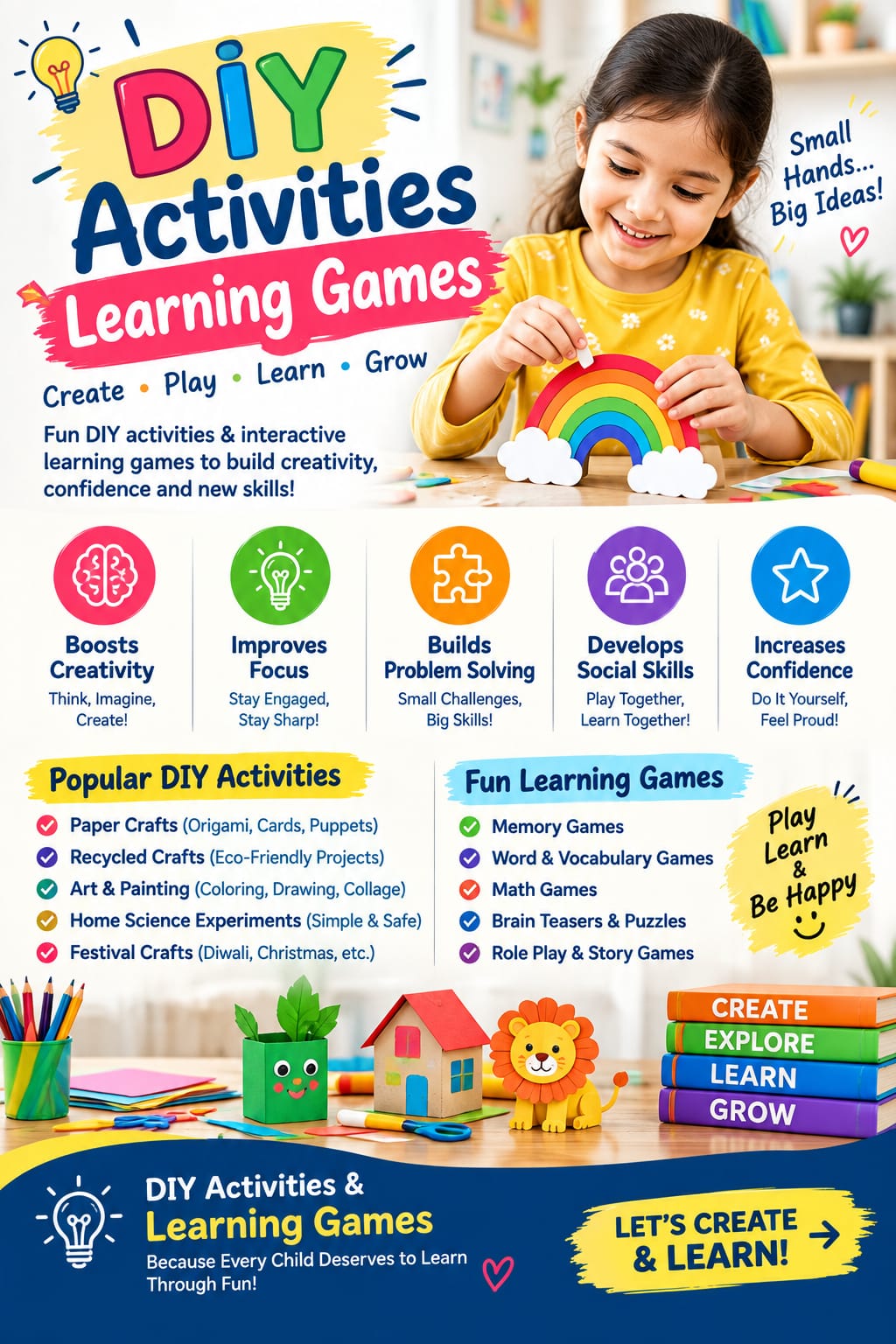
Children learn best when they are having fun. Instead of relying only on books, worksheets, and screens, parents can introduce simple DIY activities and learning games that make education more enjoyable. These activities can help children develop creativity, problem-solving abilities, communication skills, concentration, and basic academic knowledge.
The best part is that many DIY activities can be created at home using simple and easily available materials. Parents do not always need expensive toys or educational kits to keep children engaged. A little creativity can turn everyday household items into fun learning tools.
Why DIY Activities Are Important for Kids
DIY activities encourage children to participate actively instead of simply watching or listening. When children create something with their own hands, they can develop practical skills while enjoying the process.
DIY activities can help children:
Improve creativity and imagination
Develop fine motor skills
Improve concentration
Learn problem-solving
Practice communication
Understand basic concepts through play
Develop patience and confidence
Spend less time on screens
These activities can also become a great opportunity for parents and children to spend quality time together.
1. DIY Colour Sorting Game
A colour sorting game is a simple activity for young children who are learning colours.
Take different coloured paper, buttons, blocks, bottle caps, or other safe household objects. Create separate areas for each colour and ask your child to place each object in the correct group.
For example, red objects can go into the red group, blue objects into the blue group, and so on.
This simple game helps children recognize colours while also improving their observation and sorting skills.
Learning benefit:** Colour recognition, classification, concentration, and hand-eye coordination.
2. Homemade Number Matching Game
Learning numbers can become more interesting through a simple matching game.
Write numbers from 1 to 10 on pieces of paper. On separate cards, draw the corresponding number of dots or simple objects. Mix all the cards and ask your child to match the number with the correct quantity.
For example, the card showing the number "5" should be matched with the card containing five dots.
As children become comfortable with smaller numbers, parents can gradually increase the difficulty.
Learning benefit:** Number recognition, counting, memory, and basic mathematics.
3. DIY Alphabet Game
Create alphabet cards using paper or cardboard. Write one letter on each card and ask children to identify an object that begins with that letter.
For example:
A – Apple
B – Ball
C – Cat
D – Dog
Parents can make the activity more interactive by asking children to find objects around the house that start with a particular letter.
Learning benefit:** Alphabet recognition, vocabulary development, memory, and language skills.
4. Puzzle Making Activity
Instead of buying a puzzle, parents can create a simple homemade version.
Draw a picture on cardboard or print a child-friendly image. Cut it into a few large pieces and mix them together. Ask your child to put the pieces back together.
For younger children, use fewer and larger pieces. Older children can try puzzles with more pieces.
Learning benefit:** Problem-solving, concentration, visual thinking, and patience.
5. DIY Memory Cards
Memory games are excellent for improving concentration and recall.
Create pairs of cards with matching pictures, numbers, shapes, or letters. Place the cards face down and ask the child to turn over two cards at a time. If the cards match, the child keeps the pair. If they do not match, they are turned face down again.
This game can be adapted for different age groups.
Learning benefit:** Memory, concentration, observation, and cognitive skills.
6. Shape Hunt Around the House
Learning shapes does not have to happen only through textbooks.
Ask children to find objects around the house that look like different shapes.
For example:
Clock – Circle
Window – Rectangle
Book – Rectangle
Cushion – Square
Plate – Circle
Parents can make this activity into a fun challenge by giving children a list of shapes to find.
Learning benefit:** Shape recognition, observation, vocabulary, and logical thinking.
7. DIY Storytelling Cards
Storytelling is an excellent way to improve a child's language and imagination.
Create cards with simple pictures such as a tree, house, dog, car, family, or park. Ask your child to select three or four cards and create a story using them.
There is no need for the story to be perfect. Encourage children to use their imagination.
Parents can ask questions such as:
"What happened next?"
"Who was the main character?"
"How did the story end?"
Learning benefit:** Vocabulary, creativity, communication, imagination, and confidence.
8. Counting with Everyday Objects
Parents can use safe household objects to teach basic counting.
Give children objects such as blocks, pencils, toys, or bottle caps and ask them to count them. You can also introduce simple addition and subtraction.
For example, place three blocks on the table and then add two more. Ask the child how many blocks there are now.
This makes mathematics more practical and easier to understand.
Learning benefit:** Counting, addition, subtraction, and logical thinking.
9. DIY Science Experiments
Simple science experiments can turn learning into an exciting activity. Parents can demonstrate basic concepts using safe household materials.
For example, children can explore which objects float or sink by placing suitable objects in a container of water under adult supervision.
Parents can ask children to predict what will happen before testing each object.
The goal is not simply to get the correct answer but to encourage curiosity and observation.
Learning benefit:** Scientific thinking, prediction, observation, and curiosity.
10. Treasure Hunt Learning Game
A treasure hunt can combine physical activity with education.
Parents can hide small objects around a safe area and create clues for children. The clues can include simple questions, numbers, letters, or shapes.
For example:
"Find something that starts with B."
"Go to the place where you keep your books."
"Find three red objects."
This activity can be adjusted according to the child's age.
Learning benefit:** Problem-solving, reading, observation, movement, and memory.
Tips for Parents
DIY learning activities should be enjoyable rather than stressful. Parents should avoid putting too much pressure on children to complete an activity perfectly.
Keep activities suitable for the child's age and abilities. Start with simple tasks and gradually increase the difficulty.
Always supervise young children when using small objects, scissors, craft materials, water, or any item that could be unsafe if swallowed or misused.
Most importantly, allow children to make mistakes. Mistakes are an important part of learning.
How to Make Learning More Fun
Parents can make learning games more engaging by turning them into small challenges. For example, children can earn stars or stickers for completing activities, solving puzzles, or learning new words.
However, rewards do not always have to be physical. Praise, encouragement, and celebrating a child's effort can be equally valuable.
Instead of saying, "You got the answer wrong," parents can say, "Let's try it another way."
This creates a positive learning environment and encourages children to keep trying.
Final Thoughts
DIY activities and learning games are simple ways to make children's everyday learning more interactive and enjoyable. From colour sorting and number games to storytelling, puzzles, treasure hunts, and simple science activities, parents can create many educational experiences using materials already available at home.
The purpose of these activities is not to replace formal education but to complement it through playful learning. When children are encouraged to explore, create, ask questions, and solve problems, they can develop skills that are useful both inside and outside the classroom.
With a little creativity and regular parent-child interaction, learning at home can become a fun experience that children look forward to every day.
Comments (0)
No comments yet. Share your thoughts below!
Leave a Comment