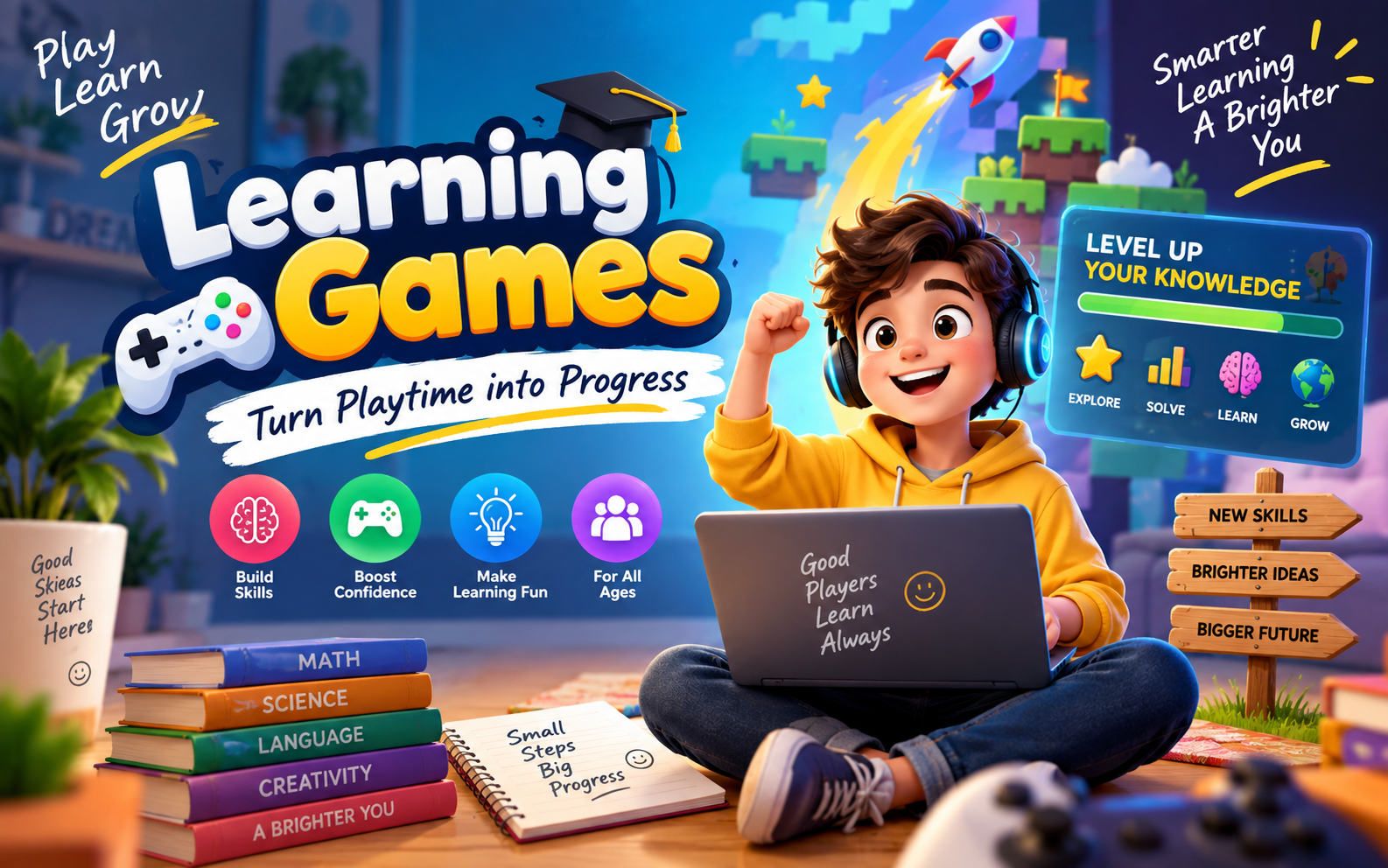
Learning Games: How Play Is Changing the Way We Learn
Learning has changed a lot over the last few years. A classroom, a textbook, and a notebook are no longer the only ways people can gain knowledge. Today, someone can learn a language on their phone, practice mathematics through puzzles, explore history through interactive stories, or understand business decisions through a simulation.
This is where learning games come in.
The idea sounds simple: combine learning with gameplay. But when it is done well, the experience can be much more interesting than simply reading information and trying to remember it later.
Think about the last time you played a game that made you want to keep trying after getting something wrong. You probably did not feel like you were studying. You were solving a problem. You wanted to beat your previous score, unlock the next level, understand a difficult challenge, or simply see what happened next.
That same feeling can be used for education.
Learning games are becoming increasingly popular among students, teachers, parents, professionals, and companies looking for better ways to train employees. They bring interaction, feedback, competition, exploration, and problem-solving into the learning process.
What Are Learning Games?
Learning games are games designed to help people develop knowledge, skills, or understanding while they play.
They can be extremely simple. A vocabulary quiz, for example, can help someone learn new words. A multiplication challenge can help children practice arithmetic. A puzzle can improve logical thinking.
They can also be much more advanced.
A business simulation might allow a player to manage a virtual company and make decisions about pricing, marketing, employees, and inventory. A science game could allow students to conduct virtual experiments. A language game might create conversations where learners have to choose the right words to continue.
The important part is that the gameplay has a learning purpose.
Simply adding points, badges, or colorful animations to a lesson does not automatically make something a good learning game. The game should encourage the player to think, practice, make decisions, or apply information.
Why Do Games Make Learning More Interesting?
One major reason is participation.
Traditional learning can sometimes be passive. A person reads a page, listens to a lecture, watches a video, and then tries to remember what they saw.
Games ask the learner to do something.
- Answer the question.
- Solve the puzzle.
- Make a decision.
- Figure out why a previous attempt failed.
- Try another approach.
That small difference can completely change the experience.
Imagine learning about fractions by reading ten pages of explanations. Now imagine solving a game where you have to divide virtual objects into equal portions to complete a level.
The mathematical concept is still there. The learner is simply interacting with it instead of only reading about it.
Instant Feedback Makes a Difference
Another useful feature of learning games is immediate feedback.
When someone answers a question incorrectly in a traditional learning environment, they may have to wait until a teacher checks their work or until the next class to understand what went wrong.
A game can respond immediately.
The player can see the incorrect answer, receive a hint, try another approach, and continue.
This creates a simple learning cycle:
Try → make a mistake → understand → try again → improve.
A wrong answer does not have to feel like failure. It can become information about what to try next.
Learning Through Repetition Without the Boredom
Repetition is important for learning, but repetition can become boring.
Nobody wants to write the same vocabulary list twenty times. Few students are excited about solving identical equations for an hour.
Games can make repetition feel different.
For example, a vocabulary game could introduce the same words through several activities. One level might ask players to match words with meanings. Another might use pictures. A later challenge could place the words inside a conversation.
The learner is still practicing the same information, but the context changes.
This gives repetition a purpose. Instead of feeling like doing the same task again and again, the learner is progressing through different challenges.
Learning Games and Children
Children naturally learn through exploration.
They ask questions, experiment with objects, repeat actions, and learn from what happens next. Games can fit naturally into this style of learning.
A well-designed educational game can introduce basic mathematics, reading, spelling, science, memory, problem-solving, and other skills through interactive activities.
For younger children, the visual and interactive nature of games can be especially useful.
Instead of asking a child to memorize a list of numbers, a game could involve counting objects. Instead of simply learning the names of animals, a game could ask the child to identify animals based on pictures, sounds, or habitats.
The learning objective stays the same, but the experience becomes more active.
Parents should still pay attention to the quality of the game. A game being labeled "educational" does not automatically mean it provides meaningful learning.
The best games give children something to think about rather than simply keeping them occupied.
Learning Games for Teenagers and Students
As learners get older, educational games can become more sophisticated.
Students can use games to practice mathematics, coding, languages, science, geography, history, economics, and logical reasoning.
For example, a coding game might give a player a virtual problem and require them to create a sequence of commands to solve it.
A history game might place the player inside a particular historical period and ask them to make decisions based on the information available at that time.
A geography game might challenge players to identify countries, cities, landmarks, or locations.
These experiences can make learning feel more connected to action.
Instead of asking only, "What is the answer?" the game can ask, "What would you do?"
That distinction can encourage deeper thinking.
Learning Games for Adults
Learning games are not only for children.
Adults also learn better when they can practice concepts rather than simply read about them.
This is one reason simulations are becoming useful in professional training.
Imagine a customer-service training game where an employee has to respond to different customer situations. The player can choose a response and immediately see how the conversation changes.
Or consider a management simulation where someone has to allocate a limited budget between different departments.
The player learns through decisions and consequences.
This type of practice can be useful because real-world situations are often messy. There may not be one obvious answer.
Games can create controlled environments where people can experiment before applying those skills in real situations.
The Rise of Gamified Learning
You may have heard the term "gamification."
Gamification means using selected game elements in a non-game experience.
These elements can include:
- Points
- Progress bars
- Levels
- Challenges
- Rewards
- Streaks
- Leaderboards
- Badges
- Achievement systems
Gamification and learning games are related, but they are not exactly the same.
A learning game is built around gameplay. A gamified learning platform might still be a normal learning system, but it uses game-like elements to encourage participation.
For example, a language-learning platform might give users points for completing lessons and maintain a daily streak.
That does not necessarily turn the entire platform into a game. Instead, game mechanics encourage learners to continue practicing.
Why Progress Matters
Learning can sometimes feel invisible.
You study for several days but may not immediately feel smarter. That can make motivation difficult.
Games are very good at showing progress.
A player can see that they completed Level 1, unlocked Level 2, improved their score, or solved a challenge that previously seemed difficult.
Learning platforms can use the same idea.
Instead of simply saying "you studied for one hour," a system might show that you completed 80 questions, improved accuracy from 65% to 82%, or mastered a particular topic.
Seeing progress can encourage people to continue. It also gives learners something concrete to work toward.
The Role of Competition
Competition can be motivating for some people.
A leaderboard can encourage players to improve their scores. A timed challenge can create excitement. Multiplayer learning games can allow students to compete with classmates or work together toward a shared goal.
But competition needs to be handled carefully.
If the same few players always appear at the top of a leaderboard, others may stop participating.
A better approach can be to combine competition with personal progress. Instead of only asking, "Who is number one?" the system can also ask, "Did you improve your own score?"
That makes the experience more accessible to different types of learners.
Collaboration Can Make Games Even More Powerful
Games do not always have to be competitive.
Some of the best learning experiences can involve teamwork.
Students can solve puzzles together, complete missions, build virtual projects, or make decisions as a group.
Collaborative games can encourage communication because players have to explain ideas, listen to others, divide tasks, and make decisions.
For example, a science game could give a group of students a virtual environmental problem. Each student could have different information, and they would need to communicate to find a solution.
Now the learning activity involves both subject knowledge and teamwork.
AI Is Changing Learning Games
Artificial intelligence is opening another interesting direction for educational games.
Instead of every learner receiving exactly the same questions, an AI-powered system can potentially adjust the difficulty based on performance.
If a learner answers several questions correctly, the system can introduce a harder challenge.
If they repeatedly struggle with a particular concept, it can provide additional practice or a simpler explanation.
This creates the possibility of more personalized learning.
AI can also be used to create conversational characters, generate scenarios, provide hints, analyze mistakes, and adapt challenges.
For example, a language-learning game could allow a player to have a simulated conversation with an AI character.
The learner has to respond naturally rather than simply selecting an answer from four options.
That can make the activity feel closer to real communication.
Virtual Reality and Simulation-Based Learning
Another growing area is immersive learning.
Virtual reality can place learners inside simulated environments.
A student studying biology could explore a virtual environment. A medical trainee could practice a procedure in a simulated setting. An engineering student could interact with a virtual machine.
The advantage is that the learner gets to experience a situation rather than only read about it.
Simulation can also provide a safe place to make mistakes.
A learner can try something, see what happens, reset the scenario, and try again.
As virtual and augmented reality technologies become more accessible, these experiences may become more common.
What Makes a Good Learning Game?
Not every educational game works equally well.
A good learning game starts with a clear learning objective.
The creator should know what the player is supposed to learn or practice.
The gameplay should support that objective.
If a mathematics game spends most of its time on unrelated animations, the player may remember the animation but forget the mathematics.
The challenge should also be appropriate.
- If the game is too easy, players can become bored.
- If it is too difficult, players may quit.
- If the feedback is unclear, players may not understand their mistakes.
- If the interface is complicated, the technology can become a distraction.
Good learning games gradually increase difficulty and provide enough feedback for players to understand how they can improve.
The Importance of Storytelling
Stories can make learning memorable.
Instead of presenting a list of facts, a game can place those facts inside a situation.
Imagine learning about ancient civilizations through a character who has to make decisions about food, trade, transportation, and survival.
The information becomes part of a larger experience.
Storytelling can give context to facts and create emotional connections with the subject.
That does not mean every learning game needs an elaborate story. A simple scenario can sometimes be enough.
The key is giving the learner a reason to care about the challenge.
Learning Games Should Not Become Distractions
There is an obvious problem with combining education and games: the game itself can become more interesting than the lesson.
If learners focus only on collecting points, unlocking rewards, or completing levels, the educational objective can get lost.
This is why game mechanics should support learning rather than replace it.
- A reward should encourage useful behavior.
- A challenge should require the learner to apply knowledge.
- A level should represent meaningful progress.
- A game should give players a reason to think.
How Parents Can Choose Useful Learning Games
Parents looking for educational games can start by asking a few simple questions.
- What does the game actually teach?
- Does the child have to think, solve, create, or remember something?
- Does the difficulty increase over time?
- Does the game explain mistakes?
- Can the child play independently?
- Are there unnecessary advertisements or distractions?
- Is the game appropriate for the child's age?
These questions can help separate meaningful learning experiences from apps that simply use educational language as a marketing tool.
Parents can also play the game themselves. Sometimes ten minutes of hands-on testing tells you more than a long description on an app store.
How Teachers Can Use Learning Games
Teachers can use learning games as part of a wider lesson.
A game does not have to replace teaching.
For example, a teacher might introduce a new concept in class, allow students to practice it through a game, and then discuss the results together.
The game becomes a practice environment.
Teachers can also use games to identify areas where students are struggling.
If many students repeatedly fail the same challenge, that may indicate that the concept needs another explanation.
This turns gameplay data into useful classroom information.
Learning Games Can Make Failure Useful
One of the most valuable ideas in game design is the ability to try again.
In real life, mistakes can sometimes have serious consequences. In a game, learners can often experiment safely.
They can make a choice, see the result, learn from it, and restart.
That can encourage experimentation.
For learning, this is important because people often understand a concept more deeply after making an error and discovering why their approach did not work.
The goal is not to eliminate mistakes. The goal is to make mistakes useful.
The Future of Learning May Be More Interactive
Education is unlikely to become one giant video game.
Different subjects require different approaches, and learners have different preferences.
But interactive learning is likely to continue growing.
Mobile devices are everywhere. AI is becoming more capable. Virtual environments are improving. Educational platforms can collect more information about how learners practice.
Together, these technologies create new possibilities.
A student might read a short explanation, solve an interactive challenge, talk to an AI tutor, enter a simulation, and then complete a real-world project.
The boundaries between studying, practicing, and playing may become less obvious.
That can work well when the technology remains focused on helping people understand rather than simply keeping them engaged.
Final Thoughts
The biggest advantage of learning games is simple: they give people a reason to participate.
Instead of only receiving information, learners can interact with it. They can experiment, make mistakes, solve problems, compete, collaborate, and try again.
That does not mean every lesson needs points, badges, or a leaderboard.
Sometimes a simple puzzle is enough. Sometimes a simulation makes more sense. Sometimes a five-minute quiz is all someone needs to refresh an idea.
The best learning game is the one where the gameplay and the learning actually belong together.
As technology continues to evolve, we will probably see more personalized challenges, AI-powered tutors, immersive simulations, multiplayer learning environments, and interactive educational experiences.
The goal should remain straightforward: help people learn something useful and make the process interesting enough that they want to keep going.
Because when curiosity becomes part of the experience, learning stops feeling like something you have to finish and starts feeling like something you want to explore.
Comments (0)
No comments yet. Share your thoughts below!
Leave a Comment