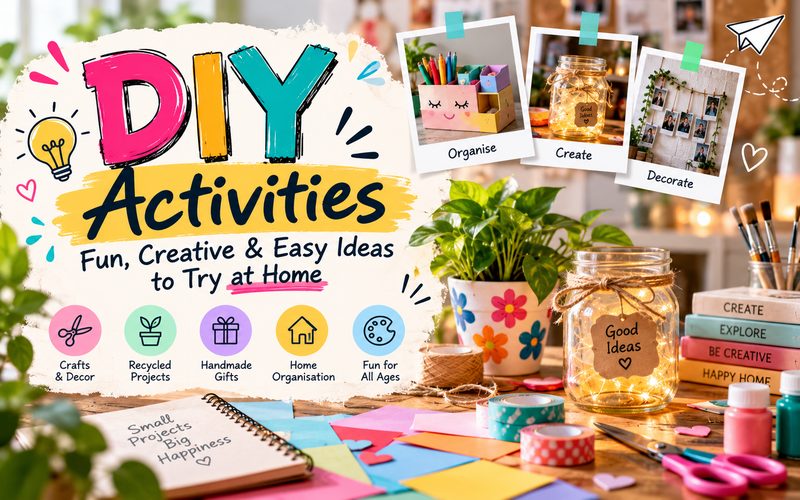
DIY Activities: Fun, Creative and Easy Ideas to Try at Home
What do you usually do when you have a free afternoon at home?
Scroll through your phone? Watch another episode of a series? Open social media for five minutes and somehow stay there for an hour?
There is another option: make something.
DIY activities can turn an ordinary afternoon into a creative project. You do not need an expensive craft kit, a professional workspace or advanced skills. A few things already lying around your home can become the starting point for something new.
That is what makes DIY interesting. The goal is not always to create something perfect. Sometimes it is about experimenting, learning a new skill, decorating your space, making a personalised gift or simply doing something away from a screen.
From recycled-material crafts and handmade decorations to simple science experiments, painting, paper projects and personalised gifts, there are hundreds of activities you can try depending on your age, interests and available materials.
Why DIY Activities Are Becoming Popular Again
DIY has always existed, but social media has made creative projects much easier to discover. A short video can turn an ordinary cardboard box into a storage organiser, an old bottle into a planter or a few sheets of paper into a decorative wall piece.
The best part is that many DIY ideas can be adapted. You can change the colours, materials, size and design according to what you already have.
DIY activities can also be useful for families. Parents can use simple projects to spend quality time with children, while students can use creative activities as a break from studying.
Adults can enjoy them too. Painting, gardening, decorating, upcycling and handmade projects can become relaxing weekend activities.
1. Make a Personalised Vision Board
A vision board is a simple creative project where you collect images, words and ideas that represent your goals and interests.
You can make one using cardboard, an old notebook, a cork board or even a digital design tool.
For a physical version, collect old magazines, printed pictures, coloured paper, markers, stickers and photographs. Divide the board into sections such as education, career, travel, hobbies, fitness, creativity or personal goals.
Then decorate it in your own style.
The interesting part is choosing what you actually want to include. Instead of filling the board with random motivational quotes, add specific goals that mean something to you.
A student might include a target course, a skill they want to learn, a dream university or a project they want to complete.
2. Turn Cardboard Boxes Into Organisers
Before throwing away a delivery box, look at it differently.
With some cutting, folding and decoration, cardboard can become a useful desk organiser.
Cover the outside with coloured paper or leftover wrapping paper. Create sections for pens, notebooks, charging cables, stationery or small accessories.
You can even create separate compartments using pieces of cardboard from another box.
This project is particularly useful for students because study desks can quickly become crowded with stationery, wires, notebooks and small objects.
Label each section and give the organiser a colour scheme that matches your room.
3. Create a DIY Photo Wall
Photos can make an empty wall feel much more personal.
Choose your favourite photographs and print them in different sizes. You can arrange them in a grid, heart shape, timeline or random collage.
For a more creative look, connect the photographs with string and small clips.
You can also add handwritten notes underneath individual photographs. A short sentence about the memory can make the wall more meaningful.
If you are creating this project with friends, everyone can contribute a few photographs and messages.
4. DIY Bookmarks
If you enjoy reading, making your own bookmarks is an easy weekend project.
Start with thick paper or recycled cardboard. Cut it into a long rectangular shape and decorate it with drawings, quotes, patterns or photographs.
You can laminate the bookmark if you want it to last longer, or cover it with transparent adhesive film.
Another simple idea is to create themed bookmarks.
- Travel-themed bookmarks
- Study motivation bookmarks
- Nature designs
- Minimal black-and-white bookmarks
- Cartoon-inspired designs
- Personalised name bookmarks
Make several at once and keep a few ready as small handmade gifts.
5. Create a Memory Jar
A memory jar is one of those DIY projects that becomes more valuable over time.
Find a clean glass jar and decorate it with ribbon, paper, stickers or a handwritten label.
Whenever something good happens, write it on a small piece of paper and place it inside.
It could be a fun day with friends, a successful exam, a family celebration, a new achievement or simply something that made you laugh.
At the end of the year, open the jar and read the notes.
You can also create a family memory jar where everyone adds notes throughout the year.
6. Make a DIY Desk Calendar
A handmade calendar can be both decorative and practical.
Create twelve monthly pages using thick paper or small cards. Add important dates, birthdays, exam dates, project deadlines and personal goals.
Decorate every month differently.
January could have a winter theme. April could use flowers. June could have a travel theme. October could feature festive colours.
Place the cards on a small stand or bind them together.
For students, the calendar can also become a study planner by adding assignment deadlines and exam preparation targets.
7. Paint Your Own Plant Pots
Plain plant pots can be transformed with a little paint.
Choose terracotta or another suitable pot and clean the surface before decorating it.
You can paint simple patterns, geometric shapes, flowers, faces or motivational words.
For children, this can become a fun family activity. Give everyone one pot and let them create their own design.
Once the paint is completely dry, add a suitable plant.
Remember to choose paints and materials appropriate for the surface and intended use, and allow everything to dry properly before handling.
8. DIY Paper Flowers
Paper flowers are inexpensive, colourful and surprisingly versatile.
You can make them using coloured paper, scissors, glue and a pencil.
Start with simple flower shapes before attempting more detailed designs. Make flowers in different sizes and combine them into a bouquet.
Paper flowers can also be used for:
- Birthday decorations
- Study room decoration
- Photo backdrops
- Gift wrapping
- Wall art
- Party decorations
Experiment with different paper textures to create different effects.
9. Create a DIY Greeting Card
A handmade greeting card can feel more personal than a generic message.
You can make cards for birthdays, anniversaries, festivals, thank-you messages or simply to tell someone you appreciate them.
Use thick paper, coloured pens, photographs, stickers and simple illustrations.
Instead of filling the card with a long message, write something specific to the person.
For example, mention a funny memory, a shared experience or something you genuinely appreciate about them.
The personal detail often matters more than complicated decoration.
10. Make a DIY Study Planner
Students can turn DIY into something practical by creating a personalised study planner.
Use a notebook or several sheets of paper and divide the pages into subjects.
Create sections for:
- Daily study goals
- Weekly targets
- Upcoming exams
- Assignments
- Topics to revise
- Questions to ask teachers
- Progress tracking
Use symbols or colours to identify completed tasks, pending tasks and difficult topics.
The advantage of making the planner yourself is that you can design it around your actual routine.
11. DIY Bookmark Corner With Paper
If you want something extremely simple, try making corner bookmarks.
Fold a square piece of paper into a small pocket that fits over the corner of a book page. Then decorate it with a face, animal, character or pattern.
Children can turn these into colourful animal bookmarks by adding paper ears, eyes and small details.
It is a quick activity that requires very few materials.
12. Create a Recycled Bottle Planter
Empty plastic bottles can be reused as small planters.
Clean the bottle thoroughly and ask an adult for help with cutting if needed, especially when children are involved.
Decorate the outside using suitable paint or paper. Add the appropriate growing medium and a suitable small plant.
You can create several planters and arrange them together near a window or balcony.
This is also a useful way to introduce children to the idea of reusing everyday materials.
13. Make a DIY Wall Quote
Choose a short phrase that you genuinely like and turn it into wall art.
Write the quote on thick paper using brush pens, markers or paint.
You can add a simple border, small illustrations or a background pattern.
Students can create study-focused wall art with reminders such as their current goals, while families can create positive messages for common areas.
Keep the design simple enough that the words remain easy to read.
14. Build a Mini Indoor Garden
You do not need a large outdoor garden to start growing plants.
A few small containers can become a mini indoor garden.
Choose plants that are appropriate for your available light and environment. Decorate the containers and place them together on a shelf or suitable window area.
You can create small labels for each plant and maintain a simple watering schedule.
For children, this can become an educational activity. They can observe changes in leaves, growth and soil conditions over time.
15. DIY Gift Wrapping
Gift wrapping does not have to look identical to something purchased from a store.
Use plain paper and add your own details.
Try handwritten names, small drawings, dried leaves, paper flowers, ribbons or simple stamps.
You can create a different wrapping style for each person.
This is particularly useful during birthdays, festivals and family celebrations when several gifts need to be wrapped.
16. Make a Simple DIY Board Game
Want to take DIY a little further?
Create your own board game.
Start with a cardboard base. Draw a path with spaces and create simple rules.
You can design a quiz game, treasure hunt, word game, memory challenge or strategy game.
Use coins, buttons or handmade paper pieces as playing tokens.
Students can even design educational games around subjects such as mathematics, science, geography or vocabulary.
The activity becomes more interesting because you are designing both the game and the rules.
17. DIY Science Activities for Kids
DIY activities can also introduce children to basic scientific ideas.
Simple supervised activities can demonstrate concepts such as floating and sinking, colour mixing, surface tension or plant growth.
The important part is asking questions.
Before an experiment, ask children what they think will happen. Afterward, compare their prediction with what actually happened.
Always choose age-appropriate activities and supervise children closely, especially when using liquids, heat, small objects or tools.
18. Create a DIY Reading Challenge
Turn reading into a creative project.
Create a reading challenge board with spaces for different types of books.
- A book by an Indian author
- A mystery book
- A biography
- A science book
- A short story collection
- A book recommended by a friend
- A book outside your usual genre
Decorate each completed section with a sticker or handwritten note.
At the end of the challenge, write down your favourite book and why you liked it.
19. DIY Friendship Bracelets
Friendship bracelets are classic DIY projects because they are inexpensive and easy to personalise.
Use embroidery thread or suitable craft cord in different colours. Start with basic patterns and gradually try more complicated designs.
You can make matching bracelets for a group of friends or create personalised colour combinations for each person.
They can also make simple handmade gifts for birthdays or special occasions.
20. Create Your Own Mini Scrapbook
A scrapbook gives you a place to combine photographs, drawings, tickets, notes and memories.
Choose a theme first.
It could be a school year, family trip, friendship memories, a festival, a hobby or your favourite moments from a particular year.
Arrange the pages chronologically or by theme.
Leave some space for handwritten notes. Years later, those small comments may become more valuable than the photographs themselves.
DIY Activities for Different Age Groups
Not every DIY project is suitable for every age. The best activity depends on the child's or student's ability, attention span and level of supervision available.
For Younger Children
Try paper crafts, colouring, simple collage projects, clay activities using age-appropriate materials and supervised science demonstrations.
For School Students
Study planners, science models, recycled crafts, board games, bookmarks, posters and simple room decorations can be good choices.
For Teenagers
Photography projects, room decoration, vision boards, digital design, handmade gifts, scrapbooks and creative journaling can provide more freedom.
For Adults
Home organisation, gardening, painting, furniture refresh projects, handmade gifts, journaling and creative decoration can turn a free weekend into a productive activity.
How to Make DIY Activities More Interesting
You do not need to follow a tutorial exactly.
Use tutorials as a starting point and then change the project.
If a tutorial uses blue paper, try another colour. If it creates a small decoration, make a larger version. If it uses a particular pattern, create your own.
This is where creativity starts.
Another good idea is to give yourself a challenge.
For example: “I have 30 minutes and only five materials. What can I make?”
Restrictions can actually make a project more interesting because they force you to think differently.
DIY Activities Can Be Great Screen Breaks
Most of us spend a large part of the day looking at screens.
Students study on laptops, communicate through phones and often relax by watching videos or scrolling social media.
A hands-on activity changes the pace.
Cutting paper, painting, arranging photographs, planting something or building a small project gives your hands something to do while your mind focuses on a different task.
You do not have to completely give up technology. You can use online tutorials to learn the technique and then put your phone away while working.
Turn DIY Into a Family Activity
DIY projects can become a simple way for families to spend time together.
Choose a project everyone can contribute to. One person can prepare materials, another can design, another can assemble and someone else can handle the finishing touches.
Do not worry about making everything perfect.
The conversation that happens while making something together can be just as valuable as the final project.
DIY Can Also Teach Real Skills
Creative activities are not only about decoration.
A child making a paper model may practise measurement and spatial thinking. A student designing a poster may learn about typography and layout. Someone building a storage organiser may learn about planning and measurement.
DIY projects can also teach patience.
Sometimes the first attempt does not work. The paper folds incorrectly. The paint looks different than expected. The design feels unbalanced.
Instead of immediately giving up, you can change the approach and try again.
That process is part of learning.
How to Start a DIY Habit
You do not need to dedicate an entire weekend to DIY.
Start with 20 or 30 minutes once a week.
Keep a small box with basic materials such as paper, glue, scissors, markers, thread, cardboard and reusable items.
When you have free time, choose one small project.
As your confidence grows, try more complex ideas.
You may eventually discover a hobby you genuinely enjoy.
Don't Focus on Perfect Results
One of the biggest mistakes people make with creative activities is comparing their first attempt with someone else's finished project.
Online videos often show the final result. You do not see the failed attempts, messy tables or hours of practice behind it.
Your first painting may look unusual.
Your first paper flower may not have the right shape.
Your first DIY organiser may lean slightly to one side.
That's okay.
The purpose of DIY is to create, experiment and learn.
Final Thoughts
DIY activities can be as simple as decorating a bookmark or as ambitious as building your own board game. You can use them to decorate your room, make personalised gifts, spend time with family, create something from recycled materials or simply take a break from your regular routine.
The most useful thing about DIY is that there is no single correct way to do it.
You can start with an idea and make it your own.
Look around your home. You probably already have paper, cardboard, bottles, jars, old photographs, unused notebooks or other materials that could become part of your next project.
Choose one thing.
Make something.
And don't worry if it isn't perfect.
Your next favourite hobby might be sitting inside that old cardboard box you were about to throw away.
Comments (0)
No comments yet. Share your thoughts below!
Leave a Comment