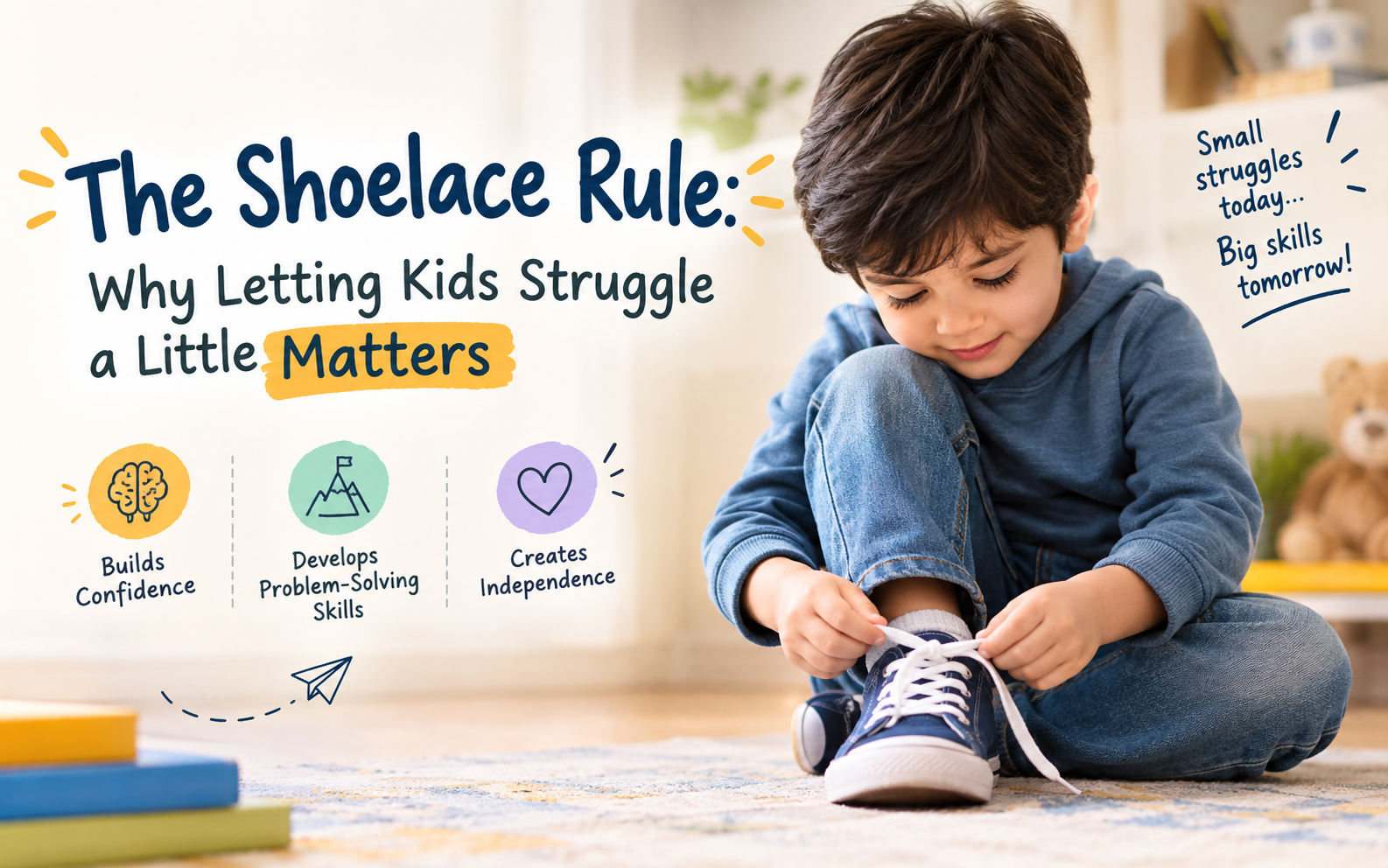
A certain kind of silence comes over a parent when their child fails at a minor task. It lasts only about four seconds. The child might be struggling with a shoelace, or be stuck on a puzzle piece, or be trying to pour the milk without spilling it, and every instinct in the parent's body tells them to just do it for the child; it would only take three seconds and then the child would stop struggling and everyone could go on with the morning.
Most of the time we yield to that instinct, not since we are impatient people, but because it is uncomfortable—almost in a physical way—to see someone we care about struggling even over a minor matter. That is why we reach across, tie the lace, pour the milk, snap the puzzle piece into place, and then the moment is over without anyone really noticing what has been lost.
A Morning With Two Shoes and One Decision
Envision Priya, who is getting her six-year-old son ready for school on a Tuesday morning that is already eleven minutes behind the scheduled time. Dev is sitting on the floor in the hallway trying to tie his shoes, and, according to her, this is the fourth day running on which he has made a real effort. The loops keep falling down and his tongue is sticking out as he concentrates. The car has to leave in six minutes.
Priya has two choices and she is conscious of both to such a degree that it seems incredibly serious considering how small shoelaces are. She can get down on her knees, tie the shoes herself in under ten seconds and thus get them to school on time with plenty of time to spare, or she can sit beside Dev, say nothing critical, make one minor remark about which loop should go under the other, and then let the following ninety seconds happen at his speed rather than hers.
She goes for the second one and so they get four minutes late for school.
The whole thing is just an example and it isn't dramatic either, with no one winning an award; yet there is something in it that merits a close examination since it reflects the real nature of the kind of choice that parents make dozens of times each day without realizing that they are making a choice.
What Was Actually Being Taught
While Dev was taking ninety seconds to tie his shoe in the end—doing it badly and with one loop clearly shorter than the other—several things occurred which had nothing to do with the shoes. He attempted a method which failed. He realised that it wasn't working even though no one had told him. He made the necessary adjustment on his own as a result of that realisation. And then, when it finally stayed secure, there appeared on his face a small, private sense of satisfaction that he had managed to do something difficult all by himself—a reaction that a parent tying the shoe for him would never have shown.
It is sometimes referred to as the just-right challenge, a term employed by occupational therapists and early childhood educators to denote activities which are right on the edge of a child's present abilities. If they are too easy, no learning takes place; if they are too difficult, there is only frustration and eventually the need for help. In between lies a narrow and worthwhile area in which a child is able to struggle, fail once or twice, and achieve success on their own.
The troubling thing is that from the outside, a child facing a just-right challenge appears exactly as if they are failing. There is no visual distinction between a child who is four seconds away from a breakthrough and one who is four seconds away from a meltdown. The only means of telling the two apart is to wait, and waiting is the most difficult aspect of the entire process.
Being Late Is Sometimes the Lesson's Price Tag
To say that this is done without any cost would be dishonest. By choosing that option, Priya lost four minutes, had a somewhat tense talk with the school office regarding her being late, and had to do the mental calculation that she has a meeting at nine which now has to begin with her rushing in a bit frazzled. Letting a child struggle is not a magic trick that results in children who are confident and competent without some sort of cost to the parent; in fact, it usually involves a cost to the parent—such as time, patience, or on occasion a small public inconvenience.
The reason it is worthwhile, most of the time, is that the cost is obvious and limited—four minutes and one delay—while the benefits build up gradually over the years in a manner which is very difficult to observe at any one moment; a child who has been let to struggle with tying his shoelaces when he is six is more likely to be the kind of child who tries to solve a difficult math problem without asking for help immediately when he is ten, or who continues to attempt a complicated bike move at eight rather than stopping after the first fall.
The Rule Is Not About Shoelaces
This doesn't imply that all struggles should be ignored. A toddler reaching for a hot stove isn't an appropriate kind of challenge. A child who is genuinely in emotional distress doesn't need to be left to work it out on their own. The skill in question is more narrow and specific in that it involves recognizing the instances when the stakes are actually low—such as when the worst that can happen is mild frustration or just a few extra minutes—and seeing those moments as opportunities rather than as inconveniences to be got rid of.
On most days there are several of these situations which don't make themselves known as being special. For example, a child having difficulty in opening a juice box. There's also the case of a child trying to explain what went wrong at recess but the parent not completing the sentence for them. And then there's a child working through long division on scratch paper while a parent, watching over their shoulder, resists the temptation to point out the error three steps too early.
What Dev Remembers
Dev doesn't recall having been late for school on that Tuesday. When he was later asked about it, he remembered that he could tie his shoes and that he had taught himself this skill; it was a small and somewhat exaggerated source of pride, something that six-year-olds tend to carry about like a badge. He wasn't aware that his mother had stood in the hallway with a clock ticking down and deliberately allowed him to fail in front of her a few more times before he finally succeeded.
The fact that this choice is repeatedly shown in a hundred small ways during a hundred small mornings is not really a parenting technique but rather a matter of respect—based on the idea that a child is capable of enduring more than the four seconds of discomfort involved in watching them attempt it.
Comments (0)
No comments yet. Share your thoughts below!
Leave a Comment