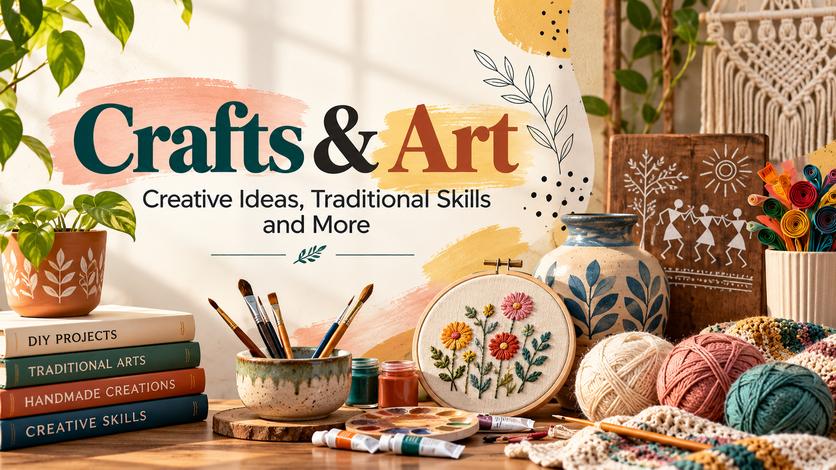
Crafts & Art: 15 Traditional Skills You Can Learn, Use, and Even Turn Into an Income
There is something special about making something with your hands.
You can spend an entire day looking at photographs, videos and social media posts, but holding something you made yourself feels different. A small painting, a clay pot, a handmade card, a piece of embroidery or even a simple paper decoration has a story attached to it.
That is why crafts and art never really disappear.
The tools change. Trends change. People discover new materials and techniques. But the basic idea remains the same: take something ordinary and turn it into something that has character.
India is especially interesting when it comes to crafts. Different regions have developed their own ways of working with fabric, clay, wood, metal, paper, natural fibres and colours. UNESCO's Intangible Cultural Heritage listings include India's traditional brass and copper utensil-making craft practiced by the Thatheras of Jandiala Guru, Punjab, and describe the skill as a tradition transmitted through generations.
Crafts are also changing with modern life.
A traditional technique can now appear on a wall hanging, notebook cover, jewellery piece, home accessory or social-media shop. Someone who once made crafts only for family occasions can potentially reach customers far outside their hometown.
That makes crafts and art interesting for two very different reasons.
You can learn them simply because they are enjoyable.
Or you can learn them because you want a practical creative skill that may eventually become a side business.
Here are some crafts and art forms that are useful, approachable and surprisingly relevant today.
Why Learn Crafts and Art in the First Place?
The easiest answer is simple: making things is satisfying.
But there is more to it.
Craft work can teach patience because some things cannot be rushed. It can improve hand coordination and attention to detail. It can also give you a break from screens, notifications and constant digital noise.
For students, crafts can become a useful creative activity.
For parents, they can turn into weekend projects with children.
For working professionals, they can become a hobby.
For entrepreneurs, they can become a product line.
And for artists, they can become a serious career.
You don't have to decide which one it will be on the first day.
Start by learning.
1. Clay Art and Pottery
Clay is one of the oldest materials humans have used to make useful and decorative objects.
The basic idea is wonderfully simple. Start with clay, shape it, dry it and, depending on the process, fire it to create something much harder and more durable.
A beginner can start with hand-building rather than a pottery wheel.
Try making:
- Small bowls
- Plant holders
- Candle holders
- Wall pieces
- Mini sculptures
- Jewellery dishes
Pottery is also a good example of how a traditional craft can fit into a modern home.
A simple handmade cup can be more interesting than a perfectly identical factory-made one because tiny differences become part of its character.
2. Madhubani Painting
Madhubani painting, associated with Bihar, is known for its strong lines, patterns and filled compositions.
For someone learning folk art, it is an interesting starting point because the style gives you a strong visual structure without requiring photorealistic drawing.
You can practise on:
Paper, canvas, notebooks, trays, bookmarks or decorative boards.
Once you understand the visual language, you can experiment with your own compositions instead of copying the same design repeatedly.
That is where learning becomes more interesting.
You stop simply reproducing a pattern and start making decisions.
3. Warli Art
Warli art is associated with Maharashtra and is recognised for its simple figures and scenes.
At first glance, the drawings look easy.
Then you try drawing an entire village scene and realise that keeping everything balanced takes practice.
Warli can work well for beginners because it relies heavily on basic shapes and repeated forms.
You can use the style for:
- Wall art
- Greeting cards
- Bookmarks
- Notebook covers
- Decorative panels
- Digital illustrations
This is also a good reminder that good art does not always depend on complicated drawing techniques.
Simple shapes can tell a story.
4. Block Printing
Block printing is another craft that fits beautifully into modern products.
A design is carved or prepared on a block, ink or dye is applied, and the design is transferred onto fabric or another suitable surface.
Traditional block-printing practices can be quite specialised, but beginners can start with simple designs and craft kits.
Try printing on:
- Cotton fabric
- Tote bags
- Cushion covers
- Table runners
- Greeting cards
- Wrapping paper
The fun part is seeing a single small design turn into a repeating pattern.
And once you understand pattern repetition, you can start creating designs that feel like your own.
5. Embroidery
Embroidery is often underestimated because it looks delicate and slow.
That is exactly why it can be so calming.
Basic embroidery only requires a few things to get started:
Fabric, a needle, embroidery thread and a hoop.
From there, you can learn stitches one at a time.
Start with simple lines, leaves, flowers and lettering.
Eventually, you can move into more detailed designs.
Embroidery also works well as a custom product.
People often like personalised pieces such as names, initials, dates, small illustrations or meaningful phrases on clothing and home décor.
The interesting part is that the design does not have to be large.
A small handmade detail can completely change an ordinary item.
6. Crochet
Crochet has made a strong comeback, especially among younger hobbyists.
The tools are inexpensive compared with many other crafts, and the material is portable.
You can carry yarn and a crochet hook almost anywhere.
Beginners often start with simple shapes and small projects:
- Coasters
- Flowers
- Keychains
- Scrunchies
- Small bags
- Scarves
- Soft toys
The nice thing about crochet is that every project teaches you something about tension, pattern reading and construction.
Once you get comfortable, you can make useful objects instead of only decorative ones.
That makes the hobby easier to maintain because you can see where your work fits into daily life.
7. Candle Making
Candle making sits somewhere between craft and small-scale product design.
The process involves more than simply melting wax and putting in a wick. You need to understand temperatures, fragrance loads, containers, wick selection and safe working practices.
Beginners often experiment with:
- Jar candles
- Decorative candles
- Wax melts
- Aromatic candles
- Gift sets
The market for handmade candles has also encouraged a lot of experimentation with packaging, colour and fragrance themes.
But there is a trap here.
A candle that looks beautiful does not automatically burn well.
Craft businesses need to care about the actual product, not just the photograph.
That is a useful lesson for any handmade business.
8. Resin Art
Resin became popular on social media because of its glossy appearance and ability to create interesting surfaces.
People use resin for:
- Coasters
- Trays
- Bookmarks
- Jewellery
- Decorative panels
- Keychains
- Table pieces
The results can look impressive, but resin requires careful handling and proper ventilation. Beginners should follow the manufacturer's safety instructions and use suitable protective equipment.
It is also a craft where patience matters.
A piece can look perfect one moment and develop bubbles, dust or curing problems later.
That is part of the learning curve.
9. Paper Craft
Paper is one of the cheapest creative materials around.
You can start with almost nothing.
A few coloured sheets, scissors, glue and a ruler can lead to a surprisingly large number of projects.
Try:
- Paper flowers
- Origami
- Pop-up cards
- Gift boxes
- Bookmarks
- Paper décor
- Quilling
- Miniature models
Paper craft is especially useful for children and beginners because mistakes are inexpensive.
You can experiment without worrying that every failed attempt has cost a lot of money.
10. Quilling
Quilling is a paper craft built from narrow strips of paper that are rolled, shaped and arranged into designs.
It is often used for:
- Greeting cards
- Wall art
- Frames
- Wedding stationery
- Nameplates
- Decorative gifts
At first, quilling can feel repetitive.
Then you start combining circles, curves, teardrops and coils into actual images.
That transformation is where the craft gets addictive.
You begin with paper strips.
You finish with something that looks far more complicated than the materials suggest.
11. Jewellery Making
Handmade jewellery can be approached at many levels.
A beginner might start with beads and basic findings.
More advanced makers can explore wire work, clay beads, metal techniques, resin, fabric jewellery or mixed-media designs.
The interesting part is that jewellery combines art with product thinking.
A piece needs to look good, but it also has to be wearable.
Weight matters.
Comfort matters.
Durability matters.
Finishing matters.
If you eventually sell your work, packaging and photography matter too.
That makes jewellery making a useful introduction to the idea of turning craft into a business.
12. Wood Craft
Woodworking sounds intimidating until you start with a small project.
You don't have to build a dining table.
Start with something manageable.
A small shelf.
A simple photo frame.
A plant stand.
A storage box.
A wooden sign.
Wood craft teaches measurement, patience and finishing.
It also teaches a lesson that digital creators sometimes forget: materials have limits.
Wood has grain.
Wood reacts to moisture.
Cuts need to be accurate.
Edges need sanding.
Measurements have consequences.
That physical feedback is part of what makes the craft satisfying.
13. Doodle Art and Illustration
Not everyone wants to make physical products.
Drawing itself can be the craft.
Doodle art is particularly approachable because it doesn't require you to produce perfect realistic portraits.
You can work with:
- Patterns
- Faces
- Letters
- Plants
- Animals
- Objects
- Abstract shapes
- Characters
One page can contain dozens of little ideas.
Over time, those small drawings can become an illustration style.
And once you develop a consistent style, it can move beyond paper.
It can appear on stickers, digital products, posters, notebooks, packaging or social-media content.
14. Textile and Fabric Crafts
Old clothes and leftover fabric can become useful raw material.
That's where textile crafts become especially practical.
You can experiment with:
- Patchwork
- Fabric painting
- Appliqué
- Simple stitching
- Fabric flowers
- Decorative cloth panels
- Handmade pouches
- Upcycled accessories
The best part is that you are giving another life to something that may otherwise sit unused.
Fabric crafts also teach you to think differently about materials.
Before throwing away an old shirt or curtain, you may start wondering:
Could this become something else?
That is a creative habit worth developing.
15. DIY Home Décor
This is where different crafts can come together.
You can combine wood, fabric, paper, paint, clay, rope, dried flowers and other materials to make objects for the home.
Think:
- Wall hangings
- Photo displays
- Decorative trays
- Planters
- Candle holders
- Macramé pieces
- Storage baskets
- Small festive decorations
The advantage of home décor projects is that you can make something for your own space first.
There is no pressure to sell it.
You simply make it, use it and learn from it.
Traditional Crafts Are More Than Decorations
One of the things people sometimes miss about traditional crafts is that they are not simply visual styles.
They carry knowledge.
UNESCO describes intangible cultural heritage as living practices that communities recognise as part of their heritage and that continue to evolve as societies change.
The example of the Thatheras of Jandiala Guru makes this especially clear. UNESCO documents how traditional brass and copper utensil-making involves shaping metal through heating, hammering and hand-finishing, with knowledge passed through generations.
So when you learn a traditional craft, you are not simply learning how to make an attractive object.
You are learning a process that may have developed over many years within a community.
That changes the way you look at handmade work.
Art Doesn't Need to Be Expensive
One of the biggest misconceptions about creative hobbies is that you need expensive supplies.
You usually don't.
Start small.
Use ordinary paper before buying premium sketchbooks.
Try basic brushes before buying an entire professional painting set.
Learn simple embroidery stitches before purchasing a giant thread collection.
Use inexpensive clay before investing in advanced pottery equipment.
Your first goal is not to build a studio.
It is to discover whether you enjoy the process.
The One-Project Rule
Here is a simple approach for beginners.
Don't start five crafts at once.
Pick one project.
Finish it.
Then decide what you want to try next.
This sounds almost too simple, but it works because finishing something teaches you more than watching another tutorial.
Maybe the first project goes badly.
Good.
Now you know what not to do.
Maybe the result looks better than expected.
Even better.
Now you know you want to keep going.
Turn a Craft Into a Skill
There is a difference between making something once and actually learning a craft.
Skill comes from repetition.
Your first ten pieces may not look very good.
The eleventh may suddenly look different.
Your hands understand the material a little better.
You start noticing proportions.
You stop fighting the tools.
You make fewer mistakes.
This is normal.
The messy first stage is part of learning.
Don't compare your first weekend project with somebody who has been making the same thing for ten years.
Compare your new work with your old work.
That's the comparison that tells you whether you're improving.
Can Crafts Become a Small Business?
Yes, but the business side is different from the craft side.
Making a beautiful product is only one part of selling it.
You also need to think about:
- Material costs
- Time spent making it
- Packaging
- Photography
- Shipping
- Platform fees
- Returns
- Customer communication
- Pricing
- Repeatability
Suppose a handmade item costs ₹150 in materials and takes two hours to make.
Selling it for ₹180 may sound like a profit.
But where did your time go?
What about packaging?
What about delivery?
What about rejected pieces?
This is why handmade businesses need proper costing.
Your craft deserves a price that reflects the work behind it.
Don't Copy Someone Else's Entire Brand
Looking at other artists is useful.
Copying everything they do is not.
Study what catches your eye.
Maybe you like their colour combinations.
Maybe you like the way they photograph products.
Maybe you like how they package orders.
Take those observations and develop your own direction.
A handmade business becomes more memorable when customers can recognise the maker's style.
That takes time, but it starts with making choices rather than reproducing somebody else's catalogue.
Use Social Media as a Workshop, Not Just a Shop
Instagram, Pinterest, YouTube and other platforms can be useful for craft creators.
But you don't have to turn every post into an advertisement.
Show the process.
Show the materials.
Show mistakes.
Show the first version beside the final one.
Show how a piece is packed.
Show how a design changes from sketch to finished product.
People often enjoy seeing how something was made.
For handmade products, the story behind the object can be part of its appeal.
Craft Activities for Children
Crafts can also make excellent activities for children.
But let the goal be creativity rather than perfect results.
A child making a paper animal does not need to produce something suitable for a magazine cover.
They need permission to experiment.
Simple activities include:
- Paper collage
- Clay shapes
- Leaf printing
- Simple painting
- Origami
- Thread art
- Paper puppets
- Recycled-material crafts
Give children materials and a starting idea.
Then let them change the idea.
That is where creativity usually shows up.
Crafts and Sustainability
Crafts can also encourage more thoughtful use of materials.
An old bottle can become a planter.
Cardboard can become storage.
Fabric scraps can become patchwork.
Paper packaging can become gift décor.
Wood offcuts can become small decorative pieces.
This does not mean every handmade object is automatically sustainable. Materials still have environmental costs, and some craft processes involve chemicals, dyes or energy-intensive equipment.
But making things can encourage a useful question:
Do I really need to throw this away?
Sometimes the answer is yes.
Sometimes the answer is: "Give me twenty minutes."
What Makes Handmade Products Special?
Machine-made products are excellent at consistency.
If you order a hundred factory-made mugs, you expect them to look almost identical.
Handmade pieces can be slightly different.
The brush line may move.
The grain may vary.
The stitch may not be perfectly uniform.
A tiny imperfection can sometimes make the object feel personal.
That does not mean poor quality should be excused.
Good handmade work still requires care.
But handmade products have something factory production cannot completely standardise: the evidence of the maker.
A Simple Beginner's Craft Box
You can create a basic creative kit without spending a fortune.
Start with:
- Paper
- Pencils
- Eraser
- Ruler
- Scissors
- Glue
- Paintbrushes
- Basic colours
- String or thread
- A craft knife, used carefully and appropriately
- A small notebook for ideas
That is enough for a surprising number of experiments.
As your interests become clearer, buy specialised materials.
There's no need to purchase everything at the beginning.
How to Find the Craft That Fits You
Different people enjoy different types of making.
If you like patience and small details, try embroidery or jewellery.
If you like working with your hands and physical materials, try clay or wood.
If you like visual patterns, explore folk painting or paper art.
If you like practical products, try candles, textiles or home décor.
If you enjoy repetition and rhythm, crochet or quilling may suit you.
If you like experimenting, mixed-media craft can be fun.
There is no test to determine your "correct" craft.
Try one.
Your reaction will tell you enough.
Final Thoughts: Make Something Before You Buy Something
We live in a time when almost everything can be purchased instantly.
Need decoration?
Buy it.
Need a gift?
Order it.
Need artwork?
Download it.
There is nothing wrong with buying things.
But there is also something satisfying about making them.
Crafts and art slow you down for a while. You notice texture. You notice colour. You make mistakes. You fix them. You start again.
And at the end, you have an object that did not exist before you sat down to make it.
That is the part many people miss.
A craft does not have to become a business.
It does not have to become a career.
It does not even have to become a serious hobby.
It can simply be something you make on a quiet Sunday afternoon.
And sometimes, that is enough.
India's craft traditions show how making can carry knowledge from one generation to another. UNESCO's documentation of the Thatheras of Jandiala Guru is one example of how a specialised craft can remain connected to community, daily use and inherited skill.
So pick up some clay.
Draw a strange little picture.
Try stitching a flower.
Make a paper box.
Paint something that does not need to be perfect.
Your first attempt may be messy.
That's fine.
The point of craft is not to make something perfect. It is to make something that wasn't there before.
Comments (0)
No comments yet. Share your thoughts below!
Leave a Comment