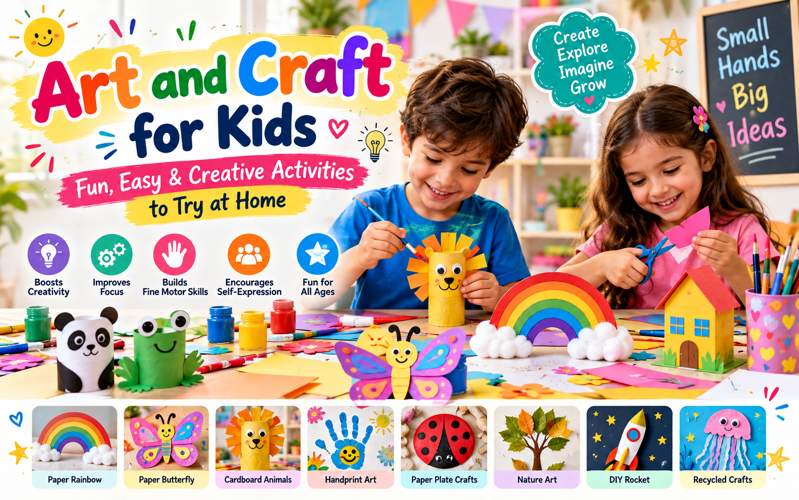
Art and Craft for Kids: 20 Fun, Easy & Creative Activities to Try at Home
Give a child a sheet of colorful paper, a few crayons, some glue and a little imagination, and something amazing can happen. A plain piece of paper can turn into a butterfly, an old cardboard box can become a rocket, and a handful of leaves can become a beautiful piece of artwork.
Art and craft activities for kids are much more than a way to keep children busy. They give children an opportunity to experiment, make choices, tell stories and create something that is uniquely theirs. From simple paper crafts to nature-inspired artwork, there are countless activities that parents and teachers can introduce without needing expensive materials.
Simple paper-based activities are particularly popular because paper, glue, crayons and scissors are inexpensive and easy to find. Recent collections of children's craft activities continue to feature paper as a practical starting point for projects suitable for different ages. [1]
So, what can children make today?
Here are 20 creative art and craft ideas for kids that can turn an ordinary afternoon into a mini creativity adventure.
Why Are Art and Craft Activities Important for Kids?
Before getting into the activities, let's talk about why craft time matters.
When children cut, fold, draw, paint, glue and build, they are actively experimenting with shapes, colors, textures and materials. Hands-on art activities can support creativity, fine-motor practice, concentration, problem-solving and self-expression. Early-childhood activity resources commonly recommend art and craft as a way for children to explore these skills through playful experiences. [2]
There is another benefit that is easy to miss: there is no single correct answer in art.
A child can make a purple sun, a green elephant or a rainbow-colored house. They are not necessarily making a mistake. They are experimenting.
That freedom can make creative activities especially enjoyable.
Before You Start: Create a Little Craft Corner
You do not need a dedicated art studio.
A small table or a washable section of the floor can become a craft corner. Keep a box nearby with basic supplies:
- Colored paper
- White paper
- Crayons and washable markers
- Child-safe scissors
- Glue sticks or child-safe craft glue
- Colored pencils
- Paper plates
- Cardboard tubes and boxes
- Cotton balls
- Yarn or ribbon
- Old newspapers and magazines
- Natural materials such as dry leaves
Keeping reusable materials around also makes spontaneous crafting much easier.
1. 🌈 Paper Rainbow
Let's start with something bright and cheerful: a paper rainbow.
What you need:
Colored paper, scissors, glue and a sheet of plain paper.
How to make it:
Cut strips of different colors. Arrange them in an arc and glue them onto a sheet of paper. Children can add clouds made from cotton balls, stars, birds or even a smiling sun.
For younger children, parents can prepare the paper strips in advance.
Creative twist: Ask your child to invent a rainbow that contains their favorite colors instead of traditional rainbow colors.
2. 🦋 Colorful Paper Butterfly
Butterflies are almost perfect for a craft project because children can decorate them in countless ways.
How to make it:
Fold a sheet of paper in half. Draw half of a butterfly shape along the fold and cut it out. Open the paper and decorate both sides with crayons, paints, stickers or small paper shapes.
Add a small paper body and antennae.
For older children, try making several butterflies in different patterns and create a paper garden.
3. 🐸 Jumping Paper Frog
Turn paper folding into a tiny game with a jumping frog.
Fold a piece of green paper into a simple frog shape. Add eyes, legs and a big smile. Once finished, children can press the folded section and make the frog hop.
A paper frog craft can become more than an art project. Create a starting line and see which frog can jump the farthest.
Paper frog projects are a familiar children's craft idea and can be adapted for different skill levels. [3]
4. 🌸 Tissue Paper Flower Garden
This craft is perfect when you want something colorful that can be displayed on a wall.
What you need:
Colored tissue paper, glue, scissors and black or green paper.
Cut flower outlines from paper. Scrunch small pieces of tissue paper and glue them inside the petals.
Use green paper to create stems and leaves.
The result can look like a cheerful garden made entirely from paper.
Fun idea: Let children name their imaginary flowers. “Rainbow Rose” or “Super Sunshine Flower” sounds much more exciting than simply “flower.”
5. 🐞 Paper Plate Ladybug
Paper plates are surprisingly useful for children's crafts.
Paint or color a paper plate red. Add black spots, eyes, legs and antennae using paper or markers.
To make it even more interesting, create a complete garden scene around the ladybug.
Add grass, flowers, butterflies, clouds and tiny insects.
6. 🐠 Under-the-Sea Paper Plate
Turn a paper plate into an underwater world.
Paint the plate blue or cover it with blue paper. Create fish from colored paper and add seaweed, bubbles, shells and other paper decorations.
Older children can create different sea creatures and make an entire “ocean wall.”
Nature and recycled-material crafts are also widely used in children's art activities, including fish artwork and projects made from everyday or found materials. [4]
7. 🦁 Cardboard Roll Animals
Do not throw away empty cardboard tubes just yet.
They can become lions, rabbits, cats, owls, monsters and much more.
Try a lion:
Cover a cardboard tube with yellow paper. Add a circular mane around the top, then draw eyes, a nose and whiskers.
Children can make an entire cardboard zoo.
This is also a fun opportunity to talk about animals while crafting.
8. 🚀 Build a Cardboard Rocket
Ready for takeoff?
Use a cardboard tube as the body of a rocket. Add paper fins, a cone-shaped top and colorful flames at the bottom.
Once the rocket is finished, encourage your child to create a space mission story.
Where is the rocket going?
Who is inside?
What planet will they discover?
Suddenly, a simple craft has become a storytelling activity too.
9. 🌳 Tree Art With Real Leaves
Go outside and collect a few fallen leaves.
Draw a tree trunk and branches on paper. Instead of drawing the leaves, glue real dry leaves onto the branches.
Children can arrange the leaves to make different tree shapes.
Make sure the leaves are clean, dry and safe to handle.
This activity combines creativity with a little outdoor exploration.
10. 🎨 Finger Painting Fun
Sometimes the best art supplies are your fingers.
Use washable, child-safe paint and a large sheet of paper.
Let children create flowers, clouds, animals, abstract patterns or completely imaginary worlds using their fingers.
There is no need to provide a detailed drawing template.
Try asking:
“What can you make using only dots?”
That one question can lead to dozens of creative ideas.
11. 🖐️ Handprint Animal Art
Trace your child's hand on colored paper and turn the shape into an animal.
A handprint can become a peacock, fish, dinosaur, bird or even a funny monster.
For a peacock, use the fingers as feathers and decorate each one with colorful patterns.
Handprint art is also something families can save as a memory of how small their child once was.
12. 🦔 Cotton Ball Hedgehog
Draw a simple hedgehog body on paper.
Instead of drawing the spines, glue small pieces of paper, cotton or other child-safe textured materials onto the body.
Let children feel the difference between smooth paper and textured craft materials.
This can turn ordinary craft time into a small sensory exploration.
13. ♻️ Recycled Newspaper Collage
Art does not always require new materials.
Old newspapers and magazines can become colorful collage materials.
Ask children to tear or cut pictures, words, patterns and colored pieces from old magazines. Then arrange them onto paper.
You can give the activity a theme such as:
- My Dream City
- Animals
- My Favorite Foods
- Space Adventure
- My Perfect Holiday
This gives children a chance to make artistic decisions rather than simply copying a template.
14. ☀️ Sun and Clouds Craft
For younger children, try a simple sky picture.
Cut a large yellow circle for the sun and fluffy clouds from white paper or cotton balls.
Add blue paper as the background.
Children can then add birds, balloons, rainbows, houses or trees.
It is simple enough for preschoolers but can also become a more detailed scene for older children.
15. 👑 Make Your Own Paper Crown
Why wait for a special occasion to become royalty?
Cut a long strip of paper that fits around the child's head. Add triangle-shaped points at the top and decorate with stickers, crayons, glitter or paper jewels.
Once the crown is finished, create a pretend royal story.
“What is the name of your kingdom?”
“What rules does your kingdom have?”
“What animals live there?”
Crafting suddenly becomes storytelling, role play and imaginative play.
16. 🎭 DIY Paper Masks
Animals make wonderful mask designs.
Children can create masks of lions, pandas, rabbits, cats, foxes or imaginary creatures.
Draw the outline on cardboard or thick paper. Cut eye holes carefully. Then let children decorate the mask.
For safety, an adult should handle any difficult cutting, especially with younger children.
17. 🧻 Toilet Paper Roll Pencil Holder
Here's a craft that can actually be useful after it is finished.
Take a cardboard tube and decorate it with colored paper, paint or stickers.
Attach a cardboard base to the bottom and use the finished holder to store pencils and crayons.
Children often enjoy crafts even more when the final product becomes something they can use.
18. 🎈 Paper Hot-Air Balloon
Create a cheerful hot-air balloon using colored paper.
Cut a large balloon shape, decorate it with patterns and attach a paper basket using strips of string or paper.
Add clouds and birds to the background.
For an educational twist, ask children why hot-air balloons rise and introduce a simple conversation about air and temperature.
19. 🧩 Shape Monster
This activity combines mathematics and creativity.
Cut circles, squares, triangles, rectangles and other simple shapes from colored paper.
Now challenge children to create a monster using only those shapes.
Maybe the monster has three eyes, four legs and a giant triangular nose.
There are no wrong answers.
After the monster is finished, ask the child to name it and tell you a story about it.
20. 🎁 Handmade Greeting Card
Sometimes the most meaningful craft is made for someone else.
Give your child paper, crayons, stickers and other decorations and ask them to create a greeting card for a parent, grandparent, sibling, teacher or friend.
They can write a message, draw a picture or simply decorate the card.
The finished card becomes more than artwork. It becomes a personal expression of love and appreciation.
Easy Craft Activities for Different Age Groups
Not every craft is suitable for every age, so it helps to adjust the activity.
For Toddlers
Choose simple activities such as finger painting, tearing paper, sticking large shapes and basic coloring.
For Preschoolers
Try paper animals, handprint art, paper plates, simple collages and nature art.
For Children Aged 6–8
Introduce more cutting, folding, simple construction projects, masks, paper characters and recycled crafts.
For Older Children
Try origami, detailed paper models, quilling, storytelling crafts, cardboard engineering projects and more complex DIY designs.
Paper crafts can be adapted across age groups, from basic tearing and sticking to more involved folding and construction activities. [5]
How Parents Can Make Craft Time More Fun
The easiest way to make art enjoyable is to avoid turning it into an exam.
Children do not need to produce perfect artwork.
Instead of saying, “That's not how a tree looks,” try saying, “Tell me about your tree.”
Instead of correcting every color choice, let children experiment.
You can also give them a creative challenge:
- Make an animal using only circles.
- Create a house for an imaginary creature.
- Build something using only recycled materials.
- Make a picture using five different textures.
- Create a character and write a three-line story about it.
These challenges encourage children to think rather than simply follow instructions.
Turn Craft Into a Learning Activity
Art and education can work together beautifully.
While making crafts, parents can naturally introduce concepts such as colors, shapes, counting, patterns, animals, seasons and storytelling.
For example, while making a paper garden, ask your child to count the flowers.
While making a butterfly, talk about symmetry.
While creating a cardboard rocket, talk about planets.
While making a leaf collage, discuss different types of leaves.
The learning does not need to feel like a classroom lesson.
That is part of the magic.
Try “Open-Ended” Crafting
One of the best ways to encourage creativity is to provide materials without giving a fixed final design.
Put colored paper, cardboard, yarn, stickers, crayons and safe recycled materials on the table and say:
“What can you make?”
At first, your child may say, “I don't know.”
Give them time.
They might eventually create a robot, a city, a spaceship, a strange animal or something that has no name at all.
That's perfectly fine.
Safety Tips for Kids' Art and Craft Activities
Creative activities should always be age-appropriate.
Use child-safe scissors and non-toxic, age-appropriate art materials. Younger children should be supervised, particularly when an activity involves small pieces, scissors, adhesives or materials that could be put into the mouth.
Keep the work surface clean and protect it with old newspaper or a washable mat.
Also remember that “recycled craft” does not mean “use anything you find.” Avoid sharp, dirty or unsafe materials.
Don't Worry About the Mess
Yes, craft activities can get messy.
Glue ends up on the table. Paint finds its way onto fingers. Paper scraps somehow appear everywhere.
It is part of the experience.
Put down an old newspaper or washable sheet before starting. Keep a cloth nearby. Dress children in clothes that can handle a little creativity.
A prepared workspace can make parents much more relaxed about letting children experiment.
Create a Weekly Kids' Craft Challenge
Want to make art a regular habit?
Create a simple weekly challenge.
Monday: Draw something from nature.
Tuesday: Make an animal using paper.
Wednesday: Create something from recycled material.
Thursday: Try finger painting.
Friday: Make a greeting card.
Saturday: Build something with cardboard.
Sunday: Family art day.
The activities do not need to take hours. Even a short creative session can become something children look forward to.
Make a Mini Home Art Gallery
Have you noticed how proud children become when their artwork is displayed?
Choose one wall, board or refrigerator area as a mini gallery.
Rotate the artwork every week.
You can even let the child choose which piece gets displayed.
This small tradition can make creative work feel valued without turning the activity into a competition.
The Most Important Rule: Let Kids Create
Sometimes adults become too focused on making the final craft look perfect.
But the real value is often in the process.
The child who chooses an unusual color is experimenting.
The child who cuts the paper differently is exploring.
The child who changes the design halfway through is solving a problem.
The child who proudly says, “I made this!” is developing ownership of their creation.
So let the butterfly have five wings.
Let the house be upside down.
Let the sun be purple.
Let the monster have seven eyes.
Childhood creativity does not need to look perfect.
Final Thoughts
Art and craft for kids can be simple, inexpensive and incredibly fun. You do not need expensive kits or a professional art room. A few basic materials and a little imagination can provide hours of creative exploration.
From paper butterflies and cardboard animals to recycled collages, nature art, finger painting and handmade cards, the possibilities are practically endless.
Most importantly, give children the freedom to create.
Ask questions. Encourage their ideas. Display their artwork. Join them occasionally. And don't be afraid of a little mess.
Because sometimes a pile of colorful paper on the floor is not a mess at all.
It is the beginning of something a child has imagined, designed and made with their own hands.
Safety note: Activities should be selected according to a child's age and abilities. Adults should supervise young children when using scissors, glue, paint, small craft pieces or other potentially hazardous materials.
Comments (0)
No comments yet. Share your thoughts below!
Leave a Comment